Brown Fused Alumina for Sandblasting: Grit Selection Guide (#12–#60)
A practical guide to choosing brown fused alumina grit for sandblasting, covering characteristics, grit size selection (#12–#60), blasting performance, and application recommendations.
XINLI ABRASIVE
12/10/20252 min read
1. Introduction
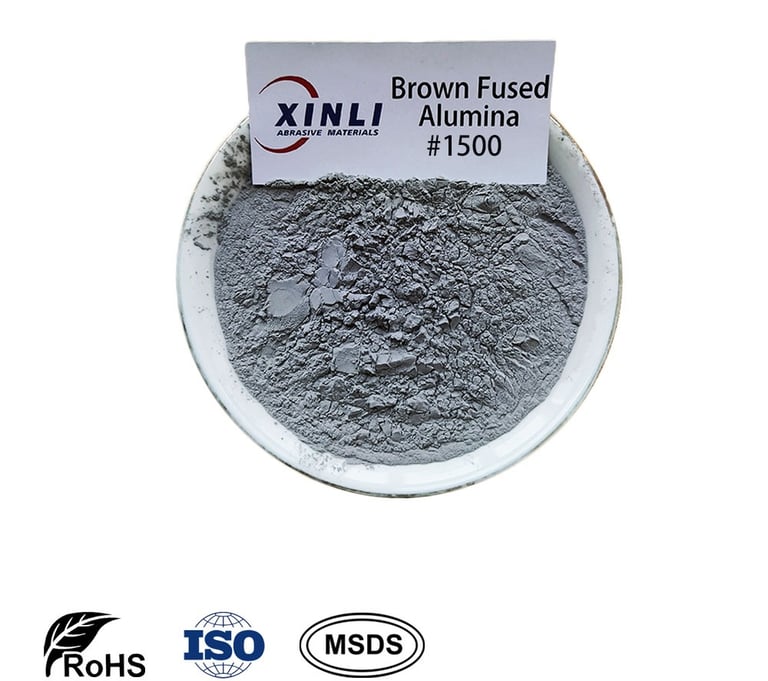
Brown Fused Alumina (BFA) is a widely used abrasive in sandblasting thanks to its high hardness, strong cutting ability, and excellent recyclability. For industries requiring aggressive material removal—such as steel surface cleaning, rust removal, and surface roughening—BFA offers a cost-effective and high-performance solution.
Choosing the correct grit size is essential because particle size directly affects surface profile, blasting efficiency, and media consumption.
This guide explains how to select BFA grit sizes from #12 to #60 for different sandblasting applications.
2. Key Properties of Brown Fused Alumina for Sandblasting
BFA is characterized by:
Mohs hardness: 9.0
High toughness (more resistant to fracturing than white alumina)
Blocky, angular particles that produce strong cutting action
Recyclability (typically 4–10 cycles depending on application)
Stable performance for dry and wet blasting
These properties make BFA ideal for aggressive blasting where deep profiles or heavy rust removal are required.
3. How Grit Size Affects Blasting Performance
The grit size determines blasting results:
Coarse grits (#12–#20) → deep surface profile, rapid material removal
Medium grits (#24–#36) → balanced cleaning + profiling
Fine grits (#46–#60) → smoother finish, surface preparation before coating
In general:
The smaller the grit number, the larger the particle, the stronger the cutting force.
4. Grit Size Selection Guide (#12–#60)
#12 – Very Coarse
Use for:
Heavy rust removal
Thick coating stripping
Deep anchor profile on steel plates
Surface profile: 80–120 μm
Very aggressive impact, suitable for large steel structures.
#16 – Coarse
Use for:
Removing old paint layers
Heavy weld cleaning
Ship hull maintenance
Surface profile: 70–110 μm
Ideal for industries requiring strong cutting power.
#20 – Coarse/Medium
Use for:
Cleaning of cast iron parts
Mill scale removal
Pre-coating surface roughening
Surface profile: 60–100 μm
Balanced cutting efficiency and abrasive consumption.
#24 – Medium
Use for:
Steel structure blasting
Pipeline surface preparation (medium profile)
General industrial cleaning
Surface profile: 50–80 μm
Most commonly used for industrial blasting lines.
#30 – Medium/Fine
Use for:
Aluminum surface cleaning
Machinery parts preparation
Removing moderate corrosion
Surface profile: 40–70 μm
Produces a moderately smooth finish.
#36 – Fine
Use for:
Precision component cleaning
Aerospace and automotive parts
Achieving moderate coating adhesion
Surface profile: 30–55 μm
Lower aggressiveness, more uniform finish.
#46 – Fine
Use for:
Light cleaning without damaging the substrate
Stainless steel blasting
Satin or matte finish
Surface profile: 20–40 μm
Ideal for non-ferrous materials.
#60 – Very Fine
Use for:
Final surface refinement before coating
Decorative finish on aluminum or stainless steel
Light oxide removal
Surface profile: 15–30 μm
Produces a smooth, uniform appearance.
5. Tips for Best Sandblasting Results
To maximize performance with BFA:
Ensure dry and clean compressed air
Maintain consistent nozzle distance (15–30 cm)
Adjust pressure based on grit size (0.4–0.7 MPa)
Use proper recycling systems to reduce dust and media loss
Replace fine particles regularly to maintain cutting efficiency
6. Conclusion
Brown fused alumina is a dependable abrasive for sandblasting due to its hardness, toughness, and aggressive cutting ability. By choosing the right grit size—from coarse #12 to fine #60—users can achieve the desired balance between cleaning power, surface profile, and finish quality.
Correct grit selection ensures better coating adhesion, higher efficiency, and a more stable blasting process.