Difference Between BFA Macro Grit and Micro Powder
This article explains the key differences between brown fused alumina (BFA) macro grits and micro powders, including particle size range, production methods, performance characteristics, and application fields.
XINLI ABRASIVE
12/10/20252 min read
1. Introduction
Brown Fused Alumina (BFA) is available in two major categories: macro grit and micro powder. Although they are made from the same fused corundum material, these two product types serve very different industrial applications.
Understanding their differences is essential for selecting the right abrasive for grinding, blasting, polishing, or refractory applications.
This article compares BFA macro grit and micro powder in terms of particle size, manufacturing processes, physical performance, and end-use functions.
2. Particle Size Range
Macro Grit
Typically ranges from #12 to #220 (FEPA F standard)
Particles are visible to the naked eye
Grain size ranges from several millimeters to around 70 μm
Examples:
#12, #16, #24, #36, #60, #120
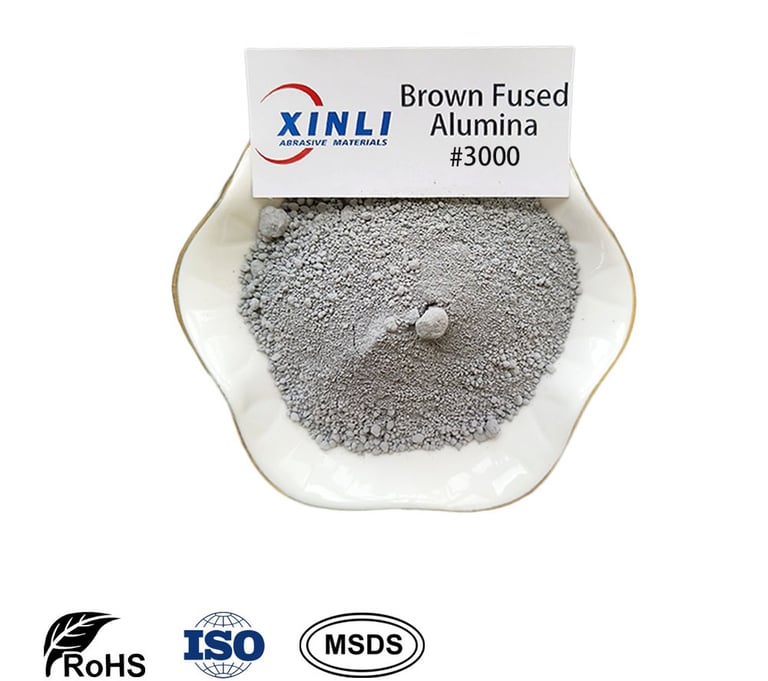
Micro Powder
Defined as finer than #240
Includes FEPA F240–F2000 or JIS #240–#8000
Particle size can be as small as 1 μm
Examples:
F600, F1000, F2000, JIS #4000, #8000
Key difference:
Macro grits are used for cutting and grinding, while micro powders are used for precision polishing.
3. Production Process
Macro Grit Production
Smelted BFA blocks are crushed
Large crushers break them into coarse fragments
Sieving separates grains into standard grit sizes (#12–#220)
Magnetic separation removes iron impurities
Final product has blocky, angular particles
Focus: shaping and screening.
Micro Powder Production
Micro powder production is more complex and precise:
Macro grit is further milled by ball mills or jet mills
Airflow classification or sedimentation is used to isolate fine fractions
PSD (particle size distribution) is tightly controlled
Shape is adjusted to sharper or more blocky profiles depending on use
Dust removal and multiple classification cycles ensure consistency
Focus: precision particle size control and fine classification.
4. Particle Shape Differences
Macro Grit
Angular, blocky shapes
Sharp edges for strong cutting force
Higher fracture toughness
Suitable for high-pressure impact (sandblasting, grinding wheels)
Micro Powder
Smaller particles with smoother or controlled shapes
Depending on the process, shapes may be:
Blocky (for lapping)
Sharp (for precision polishing)
Finer surface texture enhances polishing uniformity
Key point:
Macro grit focuses on cutting force, micro powder focuses on surface finish quality.
5. Performance Characteristics
Macro Grit Strengths
Strong impact resistance
High wear resistance
Fast material removal
Deep surface profiling
Suitable for repeated mechanical impact
Used when “aggressive grinding” is required.
Micro Powder Strengths
Narrow particle size distribution (PSD)
Produces smooth, defect-free surfaces
Suitable for ultra-fine finishing
High consistency in polishing performance
Used when “precision finishing” is required.
6. Applications
Macro Grit Applications
Sandblasting (#12–#80)
Grinding wheels / bonded abrasives (#24–#120)
Coated abrasives (sandpaper) (#24–#220)
Non-slip flooring
Refractory materials
Suited for large-scale material removal.
Micro Powder Applications
Precision polishing of metal, glass, ceramics
Lapping and superfinishing
Semiconductor wafer finishing
Optical lens polishing
Surface preparation for PVD/thermal spray
Fine grinding in specialty bonded abrasives
Suited for micro-level finishing.
7. Conclusion
Although macro grit and micro powder originate from the same fused alumina material, they play very different roles in industrial processing.
Macro grit provides strong cutting power and is used for blasting and heavy grinding.
Micro powder enables precise finishing and is essential for fine polishing applications.
Understanding this distinction helps users choose the correct abrasive grade for their production needs.